As we navigate towards 2026, the traditional paradigms of UI/UX design are rapidly evolving. The static, one-size-fits-all interface feels increasingly anachronistic. What users truly need—and what technology now allows us to build—are interfaces that don’t just react to explicit commands, but proactively adapt to their current context, goals, and even their unspoken intentions. This isn’t just about personalization; it’s about anticipating needs and shaping the user experience in real-time.
The Imperative for Intent-Driven Design
We’ve moved beyond simple responsive layouts and basic dark modes. Today’s challenge, and indeed, our opportunity, is to craft systems that deeply understand the user’s “why.” Why are they here? What task are they trying to accomplish? What information do they genuinely seek? An intent-driven interface observes, learns, and predicts, reducing cognitive load and friction by surfacing precisely what’s needed, exactly when it’s needed. Think of it as a highly skilled, unobtrusive assistant, rather than a passive tool.
For UI/UX designers, this means shifting from merely orchestrating interactions to designing intelligent systems. For web developers, it means building robust, real-time architectures capable of processing vast amounts of data for instantaneous adaptation.
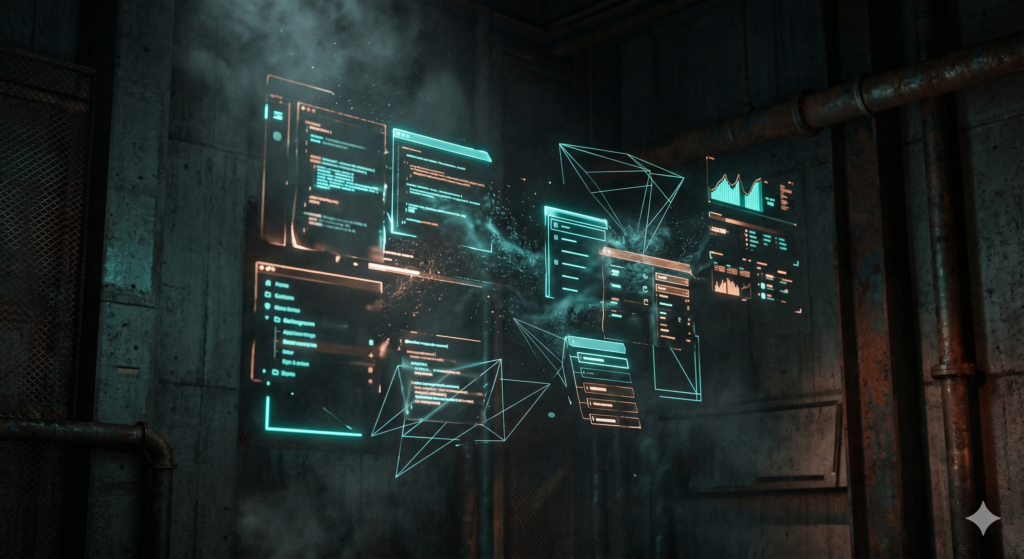
Architecting Adaptive Intelligence: Core Components
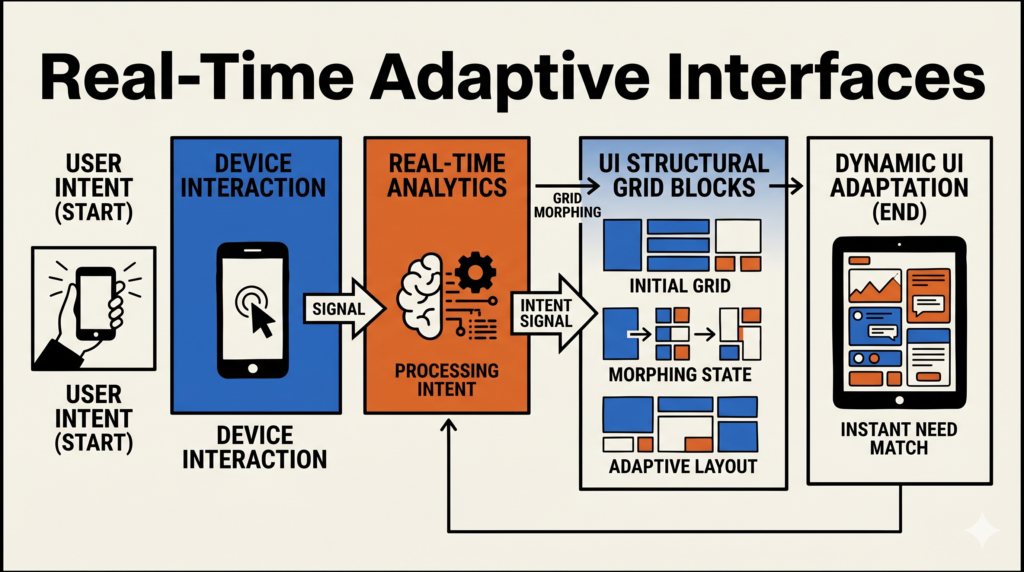
Building an interface that genuinely adapts to intent requires a sophisticated interplay of several technical layers:
- Contextual Data Ingestion: This is the foundation. We’re talking about a multi-modal data stream:
- Implicit Signals: Device sensors (location, accelerometer, light levels), usage patterns (app switching, scroll depth, idle time), biometric data (if permissible and opt-in), time of day, day of week.
- Explicit Signals: User preferences, search queries, voice commands, calendar entries, recent interactions.
- Environmental Data: Weather, local events, traffic conditions, even news headlines that might influence user behavior.
The key is low-latency processing of this diverse data to establish a rich, dynamic user context.
- Intent Recognition and Prediction Engine: This is the brain of the operation.
- Machine Learning: Sophisticated models, often leveraging deep learning, are essential here. Natural Language Processing (NLP) for textual or voice input, predictive analytics for behavioral patterns, and reinforcement learning for optimizing adaptive strategies based on user feedback (implicit or explicit).
- Probabilistic Reasoning: Intent isn’t always binary. The system often operates on probabilities, inferring a set of likely intents and preparing the interface accordingly, sometimes even pre-fetching data for multiple scenarios.
- Dynamic User Profiles: Moving beyond static personas, these profiles are living representations, continually updated with new behavioral data and contextual shifts.
- Real-Time Adaptive Interface Rendering: Once intent is recognized, the UI must transform instantly.
- Dynamic Component Selection & Reordering: Hiding irrelevant elements, promoting critical actions, or even swapping out entire sections of the UI.
- Content Curation & Generation: Tailoring information density, tone, or even generating summaries or recommendations on the fly.
- Modality Switching: Adapting to visual, auditory, or haptic feedback based on context (e.g., quiet notifications in a meeting, voice output while driving).
- Micro-Interactions: Subtle UI cues that guide the user without being intrusive, confirming the system’s understanding.
The Technical Stack for 2026
Building these systems demands a robust and scalable architecture.
- Backend Infrastructure:
- Data Streaming & Processing: Apache Kafka for ingestion, Apache Flink or Spark Streaming for real-time analytics and feature engineering.
- Machine Learning Platforms: MLOps tools integrated with TensorFlow Extended (TFX), Kubeflow, or PyTorch Lightning for training, deployment, and real-time inference at scale.
- Event-Driven Microservices: Decomposed services allowing for independent scaling and rapid development, communicating via message queues.
- Low-Latency Data Stores: Redis for caching, Cassandra or MongoDB for flexible, high-throughput data persistence of contextual and profile data.
- Frontend Architecture:
- Component-Based Frameworks: React, Vue, or Svelte remain excellent choices, facilitating modular, reusable UI elements. State management solutions like Redux, Vuex, or Zustand become critical for orchestrating complex, real-time UI changes.
- WebAssembly (Wasm): For computationally intensive client-side logic, especially in scenarios where immediate, sub-millisecond UI adaptation is crucial (e.g., client-side intent classification or complex animation rendering).
- Client-Side ML: Libraries like TensorFlow.js or ONNX Runtime Web can enable lightweight, privacy-preserving intent prediction or personalization directly in the browser, reducing round trips to the server for certain features.
- Real-time Communication: WebSockets for bidirectional, low-latency communication between client and server, feeding real-time context and receiving UI adaptation commands.
Designing for Trust and Control
While the technical prowess is exciting, the human element remains paramount. Intent-driven design is not about taking control away from the user; it’s about empowering them more effectively.
- Transparency: Users need to understand why the interface changed. Subtle explanations, ‘undo’ options, or a clear preference panel can build trust. “We noticed you’re near a coffee shop and usually order a latte on Tuesdays. Would you like to reorder?”
- User Control: Always provide an escape hatch. Users must be able to override, dismiss, or opt-out of adaptive behaviors. A truly adaptive system learns from these overrides.
- Privacy by Design: Collecting vast amounts of data necessitates stringent privacy controls. Clear consent mechanisms, anonymization, and robust data security are non-negotiable. Designers and developers must collaborate closely with legal and ethical teams from the outset.
- Graceful Degradation: What happens when the system misinterprets intent? The interface should default to a sensible, usable state rather than breaking or confusing the user. Design for uncertainty.
- Ethical AI: Actively guard against algorithmic bias. Ensure training data is diverse and that adaptive behaviors don’t inadvertently create filter bubbles or reinforce harmful stereotypes.
The Path Forward
The journey to fully adaptive, intent-driven interfaces is ongoing. It requires continuous iteration, A/B testing of adaptive strategies, and a deep commitment to user research. As designers, our role expands to defining the “intelligence” of the interface. As developers, we’re building the nervous system and brain that bring this intelligence to life.
The interfaces of 2026 will be less about rigid layouts and more about dynamic conversations, anticipating needs before they’re articulated. This is a thrilling challenge, pushing us to rethink not just how we build, but how we understand and serve our users at a fundamental level. Let’s build experiences that truly understand.